What is an excavator?
Excavators are a type of construction machinery, also known as digging machines or earth-moving machines.
Their primary purpose is to excavate trenches or remove material located above or below the machine’s own level, and then load it onto lorries or dump it at a stockpile.
Types of Excavators
Crawler Excavators – Features and Applications
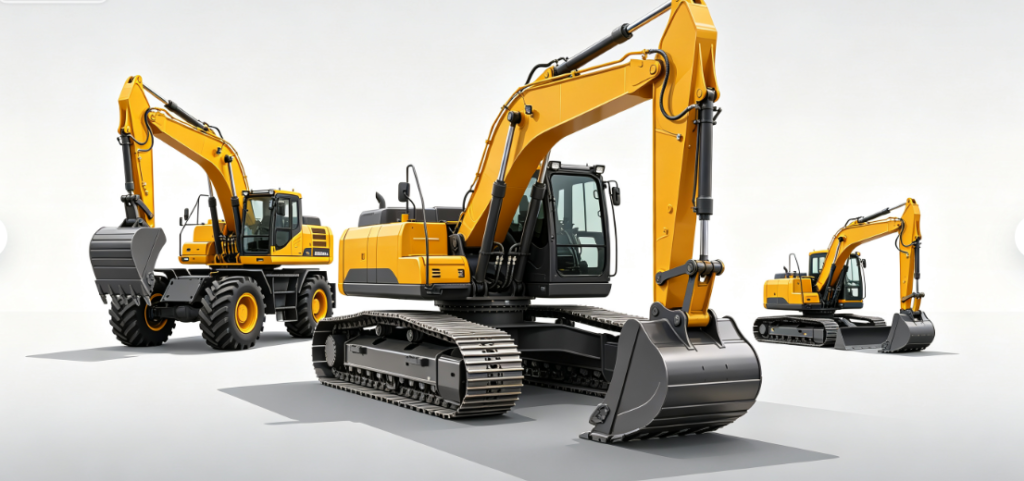
A key feature is its metal track-based undercarriage, similar to that of a tank.
It is particularly suited to working on muddy or soft ground, as the tracks provide a large contact area with the ground, effectively preventing the machine from becoming bogged down.
Furthermore, the tracks offer excellent manoeuvrability on sloping hillsides and uneven terrain.
Wheeled Excavators – Features and Applications
A key feature is that its undercarriage consists of tyres, specifically tyres designed for construction machinery.
It is suitable for use on solid ground, such as when digging trenches alongside roads. Typically, it moves much faster than a crawler excavator, so it can reach the work site under its own power without needing to be transported on a flatbed lorry.
Compact Excavators – Features and Applications
Compact excavators are a smaller variant of tracked excavators, typically weighing between 2 and 8 tonnes; a distinctive feature is that the driver’s cab is situated on top of the machine.
Compact excavators are characterised by their compact size and offer advantages in terms of transportability, energy efficiency, manoeuvrability, adaptability and high efficiency, making them suitable for working in confined spaces.
Key parameters to be considered
Crawler excavator
| Model | Operating weight | Bucket capacity | Engine power | Maximum excavation depth |
| Volvo EC200 CN4 | 20,500 kg | 0.28 – 1.1 m³ | 115 kW | 6,744 mm |
| Zoomlion ZE260E | 24.5 metric tonnes | 1.4 m³ | 133 kW | 6,870 mm |
| Divanlen R275LC-9T | 25.7 metric tonnes | 1.35 m³ | 196 kW | 6,900 mm |
| XCMG ZX130-5A | 12.5 metric tonnes | 0.52 m³ | 69 kW | 5,540 mm |
| JH60 | 6,000 kg | 0.21 m³ | 57 horsepower | 3,820 mm |
Wheeled excavator
| Model | Operating weight | Bucket capacity | Engine power | Maximum excavation depth |
| Volvo EW205 CN4 | 19,990 – 21,180 kg | 0.48 – 1.1 m³ | 129 kW | 5,565 mm |
| Divanlen R210W-5 | 20.05 metric tonnes | 0.92 m³ | 125 kW | 6,550 mm |
| XCMG XE150W | 15.318 metric tonnes | 0.58 m³ | 104 kW | 5,040 mm |
| Divanlen R60W-9 | 5.52 metric tonnes | 0.21 m³ | 56 kW | 3,500 mm |
Compact excavator
| Model | Operating weight | Bucket capacity | Engine power | Maximum excavation depth |
| Volvo EC55B Pro | 5,600 kg | 0.07 – 0.231 m³ | 38.8 kW | 4,000 mm |
| Caterpillar 307D | 7,193 kg | 0.31 m³ | 41.5 kW | 4,047 mm |
| Sany SY75C-9 | 7,280 kg | 0.16 – 0.38 m³ | 40.9 kW | 4,020 mm |
| XCMG XE15 | 1,640 kg | 0.044 m³ | 16.5 kW | 2,320 mm |
Excavator prices
Prices for small excavators range from tens of thousands to over 200,000 yuan; medium-sized excavators (12–20 metric tonnes) cost between 200,000 and 800,000 yuan; whilst large excavators (over 20 metric tonnes) can cost between 1 million and 6 million yuan.
Rising raw material costs and changes in supply and demand driven by policy trends are key factors behind fluctuations in excavator prices. Depending on their condition, second-hand excavators generally sell for between 30 per cent and 75 per cent of their original price.
Leading excavator manufacturers
- XCMG: Headquartered in Xuzhou, this state-owned enterprise holds a clear advantage in the large-scale mining equipment sector, with products renowned for their durability. Its product range covers the full tonnage spectrum from 1.5 tonnes to 200 tonnes, with excavator types including small, medium and large models, as well as wheeled, specialised, forestry and new energy variants.
- Sany Heavy Industry: An industry leader, it has held the top domestic market share for 13 consecutive years and ranks among the top three globally in terms of sales volume. Sany is currently implementing three major strategies: globalisation, digitalisation and decarbonisation.
- Caterpillar: An American brand and the global leader in construction machinery. Renowned for high reliability, long service life and a global service network, its used equipment retains high resale value. In 2025, it launched its first 100-metric-tonne-class ultra-large hydraulic excavator, the Cat 3101, in China.
- Komatsu: A Japanese brand established in 1921, renowned for precision manufacturing and low failure rates; it entered the Chinese market in 1956.
FAQ
Q: How do I choose the right excavator?
The key steps in selecting an excavator are: ‘first determine the intended application and tonnage, then choose a brand based on your budget’.
The application scenario depends on the specific conditions in which the excavator will typically be used. For example, for indoor renovation, orchard work and occasional municipal tasks, a small excavator (2–8 tonnes) is suitable;
if you require versatility across a wide range of scenarios—covering 80 per cent of common applications such as earthworks and building foundation work—a medium-sized excavator (12–20 tonnes) is recommended; for large-scale operations such as mining or major earthworks, a large excavator (20 tonnes and above).
As for brands, if your budget allows, choose Caterpillar—a premium brand known for its highly reliable products. For value for money, mid-range brands such as Sany, XCMG and Lingong are good options.
Q: What is the average price of an excavator?
There is no average price for excavators; prices vary significantly depending on the brand, tonnage and condition.
Here are some price ranges for your reference: small excavators range from tens of thousands to over 200,000; new medium-sized excavators (12–20 tonnes) cost between 400,000 and 800,000; and large excavators (over 20 tonnes) range from 1,000,000 to 6,000,000.
Second-hand excavators, depending on their condition, typically cost between 30% and 75% of the original brand’s price.
Q: What is the difference between crawler excavators and wheeled excavators?
Crawler excavators are suitable for complex terrain, soft ground and heavy-duty operations, such as on slopes or sandy ground. They exert low ground pressure and are less likely to get stuck, but require a flatbed lorry for transport between sites.
Wheeled excavators can travel on roads at speeds of up to 30 km/h and are suitable for urban work and frequent site moves, but they offer poorer stability and generally have less digging force than crawler excavators.