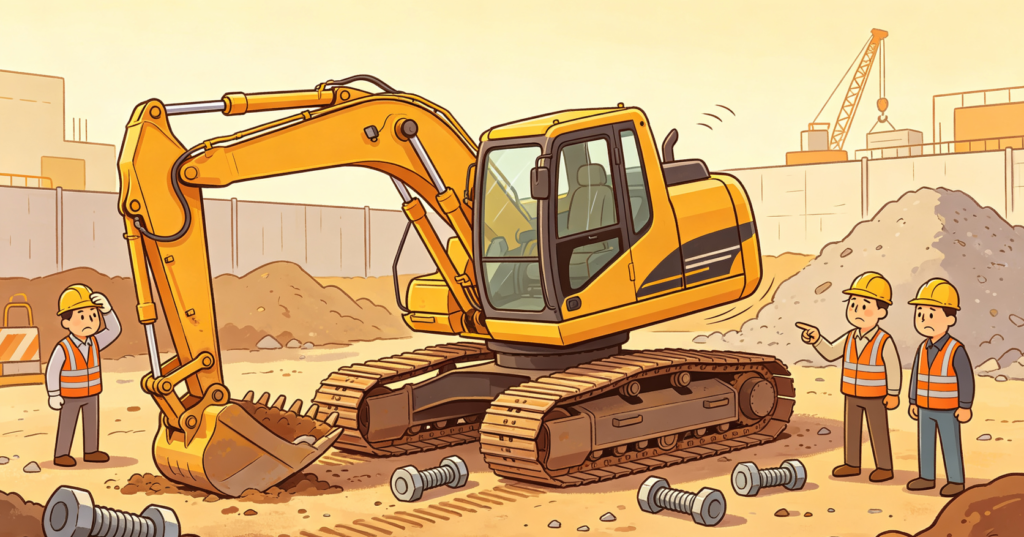
You ever been on a job site and heard some old-timer say, “Hey kid, don’t keep swinging that thing in circles – you’ll unscrew the cab right off the tracks”?
I have. Actually, I heard it more than once.
First time was maybe ten years ago. A guy I was working with swore his cousin saw it happen on a demo site in Texas. Twenty-something turns counter-clockwise and pop – the whole upper structure just spun clean off. I remember thinking, no way that’s real. But I didn’t say anything, because I wasn’t sure.
Fast forward to last month. I’m scrolling Reddit and there it is again – a whole thread asking can an excavator unscrew itself? People arguing back and forth. Some say it’s total BS. Others swear they’ve felt the machine get “loose” after too many spins.
So I dug into it.
Turns out, the answer is interesting. Not just a simple “yes” or “no” – there’s actually a real mechanical story behind it, and the truth might surprise you.
First Thing’s First – What’s Holding That Thing Together?
Let’s get the basics out of the way. To really answer can an excavator unscrew itself, you need to know what’s actually connecting the two halves.
An excavator has two main parts: the house (where the cab and boom live) and the undercarriage (the tracks). The thing that connects them is called a slew ring – sometimes called a swing bearing.
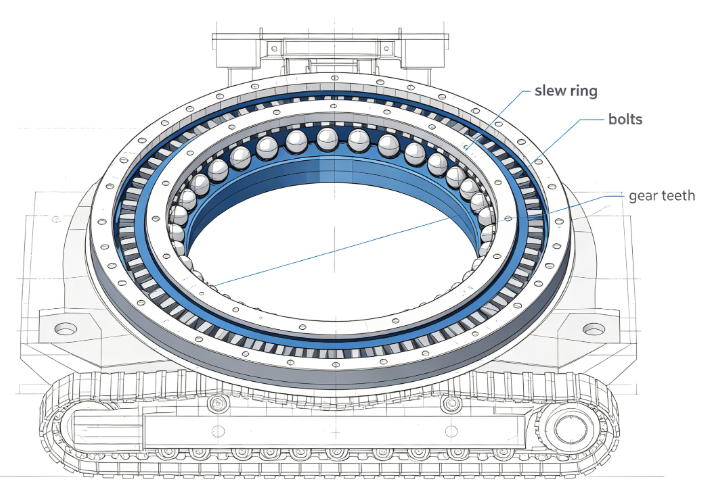
Here’s what it actually is: a giant ring made of hardened steel, packed with metal balls or rollers that run in precision-ground grooves. It’s basically a massive ball bearing that can handle tons of weight while letting the top half spin freely.
And here’s the key – it’s not a thread.
Not a single thread on that entire joint. It’s a bearing with internal gears. The house spins on those rollers, driven by a hydraulic motor that meshes with the ring’s internal teeth.
So mechanically speaking, an excavator cannot unscrew itself from the undercarriage. There’s nothing to unscrew. The house and tracks aren’t threaded together like a bolt and nut – they’re connected like a lazy Susan, just way beefier.
If someone tries to tell you it’s threaded, ask them where the threads are. Watch them pause. They won’t have an answer.
So Where Did the “16 Turns” Story Come From?
The version I hear most goes like this: if you rotate the house more than sixteen times in the same direction, the bolts that hold the slew ring will gradually work loose. Spin it enough, and the whole top eventually separates from the tracks.
In other words, they believe an excavator can unscrew itself if you spin it enough.
Sounds believable, right? Spin something a bunch of times, things get loose. We’ve all twisted a screwdriver too many times and stripped a screw. Same logic, just bigger.
Except the logic doesn’t hold up to five seconds of scrutiny.
Think about what an excavator does all day. It slams buckets into rock. It pries boulders out of the ground. It swings heavy loads back and forth constantly. If the joint connecting the house and tracks could “unscrew” from rotation, it would’ve been designed out of existence decades ago. The shock loads alone would destroy a threaded connection in the first hour of work.
And then there’s this: you can see the slew ring on any excavator. It’s a flat, ring-shaped assembly with bolts going straight down through it. Look at it. There’s no thread. No spiral. No way for the house to “climb” up and off.
The whole “16 turns” number is pulled from thin air too. Some versions say 16, others say 20, some say “over a dozen.” Nobody’s ever been able to tell me where that number came from. It just appeared one day on a forum and stuck.
Okay, But Something Does Come Loose
Here’s where it gets interesting.
While the answer to “can an excavator unscrew itself?” is a hard no, the bolts holding the slew ring to the frame absolutely can come loose. And that’s a real problem – one that actually happens on job sites.
Let me give you a real example.
I came across a case on a heavy equipment forum. A Bobcat 335 excavator had all sixteen bolts that secure the slew ring to the cab – every single one – sheared right off. The operator heard a loud crack, felt the house go wonky, and shut it down.
They replaced the bolts, torqued them to spec, and put the machine back to work. Less than 50 hours later, the same thing happened again.
So what went wrong?
The mechanics on the forum kicked it around for a while. A few possibilities:
- Bad torque from the start – bolts were never tight enough
- No threadlocker – or the wrong kind
- Vibration – constant shaking just walked the bolts loose over time
- Warped mounting surface – the base where the slew ring sits was slightly bent, so the bolts couldn’t clamp evenly. One guy pointed this out and said it’s actually pretty common – especially on machines that’ve been abused.
The real culprit in most cases? Loss of preload.
Preload is the tension you create when you torque a bolt. That tension clamps two parts together tight. As the machine vibrates and takes hits, that preload slowly fades. Bolts get a little looser. The load shifts to neighboring bolts. And eventually, you get a chain reaction – one breaks, the rest follow.
So the real risk isn’t the excavator unscrewing itself. It’s the bolts failing because you didn’t check them.
What About Continuous Rotation – Does That Cause Wear?
I got another question while researching this: does spinning counter-clockwise all day cause more wear than clockwise?
Honestly, I wondered the same thing.
But the slew ring doesn’t care which way you spin. It’s designed for bidirectional rotation – the bearings and raceways are completely symmetrical. Clockwise, counter-clockwise, doesn’t matter. The wear rate is identical.
What actually kills a slew ring is:
- Lack of grease – running it dry
- Dirt and contamination – water, sand, concrete dust getting past the seals
- Overloading – pushing the machine past its capacity repeatedly
- Structural damage – the mounting frame gets bent, the ring distorts
If you spin the machine in circles all day, the slew ring doesn’t care. It was made to do exactly that.
(Now, if you’re doing pivot turns on your tracks all day, that’s a different story. Those tear up the undercarriage pretty quick. But we’re talking about the slew ring here.)
How Do Hoses and Wires Not Get Twisted?
This is actually a smart question. If the house can spin infinitely without stopping, how do the hydraulic lines and electrical cables not get wrapped around each other?
The answer is a part called the central rotary joint – or swivel joint.
Think of it like a two-piece tube. One half is connected to the upper house. The other half is fixed to the undercarriage. They can spin freely relative to each other, but oil and electricity still pass through.
It works like a garden hose swivel that never tangles. No matter how many times you spin the house, the hydraulic lines stay put.
The fact that this part exists tells you everything: excavators were designed to spin continuously. If spinning caused the machine to unscrew itself, engineers wouldn’t have built a part that allows – and encourages – unlimited rotation.
It just wouldn’t make sense.
Has an Excavator Ever Actually Separated?
Let’s be honest: yes – but not for the reason the myth says.
Here’s what I mean:
If the slew ring bolts fail – like all of them, or enough of them – the house can separate from the tracks. That’s a real thing. It’s happened before and it’ll happen again.
But it’s not the machine “unscrewing itself.” It’s bolts breaking because they weren’t maintained.
Think of it this way: a bridge doesn’t “fall down on its own.” It collapses because the supports failed. You wouldn’t say “bridges just fall down sometimes” – you’d say “the bolts rusted” or “the concrete cracked.”
Same with an excavator. If the house comes off, it’s because the bolts were loose or broken. Not because someone spun it too many times.
Getting this distinction right matters. Because if you believe the myth, you might ignore the real maintenance that actually prevents these failures.
Why Does This Myth Stick Around?
I spent a while thinking about this, because it’s genuinely interesting. Why does a story that’s so obviously false – once you look at the machine – keep coming back?
A few reasons.
It sounds plausible. Most of us only know threaded connections from screws, bolts, and jars. We see something that rotates and assume it works like a thread. The brain takes a shortcut.
It borrows real mechanical terms. The myth talks about bolts loosening, vibration, fatigue – all real things. It wraps a false story in true language, and that makes it harder to spot.
It’s memorable. “A twenty-ton excavator unscrewed itself and fell apart” – that’s a way better story than “the bolts needed retorquing.” The truth is boring. Myths are juicy.
The job site grapevine. This stuff gets passed down from operator to operator, no one checks the manual, and suddenly it’s “common knowledge” that doesn’t happen to be true.
So What’s the Bottom Line?
Straight answer: No. An excavator cannot unscrew itself.
The connection between the house and tracks is a bearing and gear system, not a threaded joint. The machine is built to rotate in both directions without limit. Spinning it in circles won’t cause the cab to separate from the tracks.
But the bolts that hold that bearing in place? They need checking.
That’s the real takeaway. Stop worrying about the “unscrewing” myth and start worrying about bolt torque, grease intervals, and seal condition. Those are the things that actually keep the machine together.
Practical Tips If You Run One
If you’re an operator or a foreman, here’s what matters:
Torque check: On a new machine, check every single bolt after the first 50 hours. After that, check about 10% of them every 250-500 hours. If you find even one loose, stop what you’re doing and check every bolt.
Don’t rely on sound: Hammering bolts to “hear” if they’re tight doesn’t work on high-strength fasteners. Use a torque wrench. A calibrated one.
Grease matters: Pump grease into the slew ring every 100 hours. And – important step – rotate the house while you’re greasing. At least two full turns. Otherwise the grease just piles up near the fitting and never reaches the rest of the ring. Keep going until fresh grease pushes out evenly from the seals – that tells you the old stuff (and the metal shavings and dirt that came with it) is out.
Check the seals: If those rubber seals tear or harden, water and sand get in. Once that happens, the bearing doesn’t have long.
Measure play: If the axial play exceeds about 0.5 millimeters (roughly 0.02 inches), that bearing needs replacing. Not soon – immediately.
Final Thought
I read through a bunch of forum threads while researching this. One comment stuck with me.
Someone said: “I asked my dad about this. He’s been running excavators for thirty years. He said he’s never seen one unscrew, but he’s seen plenty of bolts snap because nobody checked them.”
That’s the whole story right there.
The myth is harmless fun until it stops people from doing real maintenance. Don’t let that be you.
Spin the machine however you want. Just check the bolts.
References: Arnold’s Equipment Rentals, Boom & Bucket forum, EngineerFix, Vikfin, Heavy Equipment Forums, Plant Parts, Ningguo Swbtec, Slew Bearing Tec, DeKai Attachment, Yikaide, and related technical literature.
Frequently Asked Questions
Q: Can an excavator really unscrew itself?
Absolutely not. There’s no thread in the connection. The house and tracks are connected by a bearing and gear assembly. Spinning it won’t unscrew anything.
Q: What makes people think an excavator can unscrew itself?
Probably the “visual shortcut” effect. People see a big rotating joint and assume it works like a bolt. Then the story spreads on job sites and forums until it becomes “common knowledge.”
Q: I heard spinning counter-clockwise causes more wear – true?
Nope. The slew ring is symmetrical. Direction doesn’t affect wear. Lack of grease and dirt do.
Q: What actually causes the house to come off?
Bolt failure. The bolts holding the slew ring can break or back out if they aren’t maintained. That’s a real safety issue, but it’s not “unscrewing.”
Q: How often should I check the slew ring bolts?
New machine: first 50 hours, check all of them. After that: spot-check 10% every 250-500 hours. If any are loose, check every single bolt.
Q: How does the machine keep spinning without twisting hoses?
Central rotary joint (swivel joint). It lets oil pass from the house to the tracks while everything spins freely.
Q: Does continuous rotation damage the slew ring?
No. It’s made to spin continuously. What damages it is running it dry, letting dirt in, or overloading it.
Q: Can I grease the slew ring without rotating the house?
You can, but you’re wasting your time. The grease just sits in one spot. You need to rotate at least two full turns while greasing to get even distribution.
Q: How much play is too much in a slew ring?
Over 0.5 mm (0.02 inches) is a red flag. Replace the bearing.
Q: Why does this myth keep coming back?
Because it sounds believable, it’s easy to remember, and nobody bothers to check the actual design of the machine. That’s how all good myths live on.
Other articles
发表回复