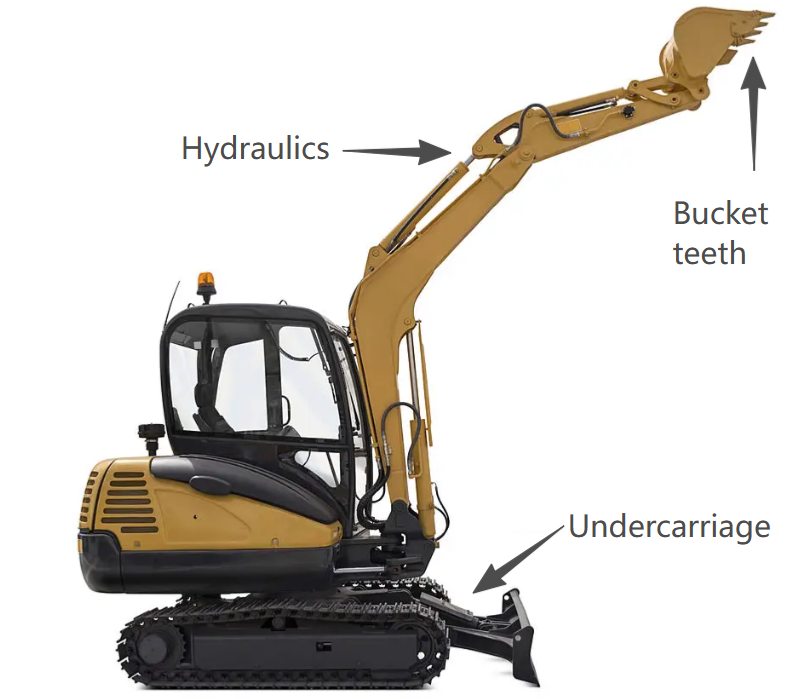
Start with a real cost comparison
A purchasing manager in Australia had two quotes for a ripper on a 5-tonne machine. AUD 800 for the cheap one, AUD 1,200 for the better one. He saved AUD 400. The shank snapped in week two. Downtime at AUD 150/hour for 15 hours, expedited air freight, and fitter labour pushed the total past AUD 4,000.
That gap — between the invoice price and the real cost — is what this guide is about. Three habits prevent most of it. Buy wear parts on cost per hour, not cost per unit. Measure the sprocket every time you replace a track. And check a mini excavator parts supplier on paperwork, not price.
Undercarriage: where most of your parts budget goes
The undercarriage is the single biggest cost center on any tracked machine. Industry data puts it at roughly 20% of the machine’s purchase price but nearly 50% of lifetime repair costs. Some estimates go higher — up to 50–70% of a tracked machine’s lifetime maintenance spend.
Rubber tracks on a mini excavator typically last 1,200–2,000 hours. Well-maintained ones can reach 2,000; neglected ones can fail in 400. Steel chains run 3,000–6,000 hours. Track rollers on mini-class machines generally fall in the 3,000–5,000 hour range. Sprockets usually need attention every 2,000–3,000 hours.
These are planning ranges, not guarantees. A 15-minute inspection per machine at each service catches most roller problems early. Compare left and right rollers — one side often wears faster and reveals a track tension issue.
The most expensive mistake in this category: replacing a track without measuring the sprocket. A hooked sprocket destroys a new track in weeks. If your track is past 2,000 hours, measure the sprocket first.
Hydraulics: expensive, and usually blamed wrongly
Hydraulic pumps get replaced when the real problem is dirty fluid, a clogged filter, or a failed seal. A weeping cylinder is a reseal job now or a cylinder replacement later.
Service intervals vary by brand. A typical pattern: engine oil and filter around 250 hours, hydraulic filters around 500 hours, hydraulic fluid at 1,000 hours or by oil sampling. Some brands stretch hydraulic fluid further, but your manual is the authority.
Quality piston rods carry hard-chrome plating around 800–1,000 HV. That number is measurable. Ask for it.
Bucket teeth: buy on cost per hour
Teeth, adapters, cutting edges, and side cutters are consumables. The question is never what a tooth costs — it is what it costs per hour of work.
Tier-one aftermarket teeth typically cost 15–40% less than OEM while delivering comparable wear life when sourced from a certified manufacturer. Bucket teeth generally last 200–500 hours depending on material abrasiveness.
Ask for the material grade. AR450 or AR500 for wear plate. 40Cr for track rollers. If a supplier cannot tell you the grade and the heat treatment, that tells you something.
OEM and aftermarket: not a binary
Well-sourced aftermarket parts frequently match OEM life for wear and structural components. For precision hydraulic and electronic parts, OEM tolerances are usually tighter. Structural components require weld certification and material traceability.
Aftermarket bottom rollers from reputable manufacturers can cost 30–50% less than OEM while maintaining equivalent performance. The key word is reputable.
Warranty term is a marketing variable. Compare scope, not length. Ask whether downtime and labour are covered. Most warranties exclude the only cost that matters.
How to check a supplier
Ask these before you trust anyone. Do they keep material test reports traceable to batches? Do they run a spectrometer for chemical composition and a hardness tester? Is hardened-case depth measured? Do they use CMM or 3D scanning for fitment? Does the fitment guarantee cover wrong-part returns and freight both ways? What do the written warranty terms actually say — term, scope, exclusions, remedy, claims process, and whether downtime and labour are covered?
A supplier who answers those in writing is a different category of business from one who cannot.
For export packing, solid wood must meet ISPM 15 — heat treated to 56°C core for 30 minutes or fumigated, with the IPPC mark on the crate. Without it, your shipment sits at the border.
Common failures and a maintenance rhythm
| Symptom | Likely cause | Action |
| Engine won’t start | Fuel contamination; flat battery; starter | Bleed fuel; test battery; check starter |
| Hydraulics dead | Low fluid; failed hose or seal | Top up; replace; flush circuit |
| Slow response | Contaminated fluid; worn pump | Change fluid and filters; test pump |
| Erratic bucket | Cylinder internal leakage; worn pins | Reseal cylinder; replace pins |
Daily: check leaks, hoses, track tension. Every 250 hours: engine oil and filter. Every 500 hours: hydraulic and air filters. Every 1,000 hours: hydraulic fluid and coolant. Grease pins and bushings every 8–10 hours.
Keep your own hour log. Within a year you will predict failures instead of reacting to them.
The market is growing, and buying is shifting
Two research houses put global mini excavator market growth at 4.6% to 5.65% CAGR through the early 2030s.①② Europe and North America hold the largest installed base, and a big share of that fleet is entering the 1,500–2,500 hour service window — exactly when undercarriage parts get ordered.
On the demand side, Google procurement searches for mini excavator undercarriage parts rose 32% year on year, with track rollers, carrier rollers, idlers, and sprockets ranking as the most searched components. The four most searched chassis wear parts are bottom track rollers, top carrier rollers, idler wheels, and drive sprockets.
Tighter emissions rules are retiring older machines, which means the service population keeps growing even as new sales shift. For mini excavator parts buyers, that means more direct sourcing and more pressure to verify suppliers before ordering.
Before you order
Three things. Verify the specification against your serial number, not the model year. Measure the sprocket whenever you replace a track. Track cost per hour rather than cost per part.
Do those three, and the mini excavator parts arithmetic works in your favour.
Mini Excavator Parts FAQ: 12 Questions I Get Asked Most
Q1: How long do rubber tracks on a mini excavator last?
Well-maintained tracks typically serve 1,500–2,000 hours. Neglected ones can fail in as little as 400 hours, according to TVH field data. The real variable isn’t the track — it’s the ground and the operator
Q2: How do I know my undercarriage needs work?
Uneven track wear, constant tension adjustments, or loud noises while operating are the clearest signals. A wobbling idler or a roller that won’t turn by hand is next.
Q3: What’s the most common mistake when replacing tracks?
Replacing a track without measuring the sprocket. A hooked sprocket destroys a new track in weeks. If your track is past 2,000 hours, measure the sprocket first.
Q4: How do I measure sprocket wear?
Visual first: look for flattened or sharp edges, excessive grooving, or teeth that hook forward. Then measure tooth height with a caliper against the OEM minimum spec. Replace when tooth height hits 50% of original, or always replace sprocket and chain together if chain pitch is stretched
Q5: Are aftermarket mini excavator parts as good as OEM?
For wear parts and structural components, good aftermarket frequently matches OEM life. Tier-one aftermarket teeth, for example, hit 46–52 HRC — same hardness band as OEM — at 15–30% lower piece price. For precision hydraulic and electronic parts, OEM tolerances are usually tighter
Q6: Does using aftermarket parts void my warranty?
It depends on the machine’s warranty terms and the part category. Many OEM warranties require approved or OEM-certified parts for certain components. Until the warranty period expires, OEM is the lower-risk choice for any part that could be cited in a warranty claim
Q7: What’s the difference between OEM, quality aftermarket, and cheap aftermarket bucket teeth?
Hardness and tolerance. OEM and tier-one aftermarket both run 46–52 HRC with ±0.05 mm tolerance on locking surfaces. Low-tier aftermarket runs 38–42 HRC and ±0.10–0.20 mm. The loose tolerance causes premature adapter wear and tooth loss.
Q8: How often should I grease pins and bushings?
Every 8–10 operating hours, or per your manual. This is the interval most often stretched. The parts are cheap; the labour to replace them isn’t.
Q9: What maintenance intervals should I follow?
A typical pattern across major brands: engine oil and filter at 250 hours; hydraulic and fuel filters at 500 hours; hydraulic fluid and full undercarriage inspection at 1,000 hours. Track tension sag should sit between 10–30 mm at mid-point, per OEM spec.
Q10: Can I still get parts for an older machine?
Generally yes. Major brands sustain availability for a long time, and the aftermarket specifically serves legacy models. The constraint is part-number lookup — which is why serial-number-based ordering matters more, not less, on older equipment.
Q11: What’s the difference between a mini and a full-size excavator, parts-wise?
Same categories, different duty cycle. Full-size machines run 14 to over 100 tons on steel undercarriage with heavier hydraulics. Minis run 1–10 tons, use rubber tracks far more often, and have less margin — smaller fluid volumes and lower tolerance for contamination.
Q12: What should I check before placing a parts order?
Three things. Verify the specification against your serial number, not the model year. Measure the sprocket whenever you replace a track. And track cost per hour rather than cost per part.
Other articles
发表回复