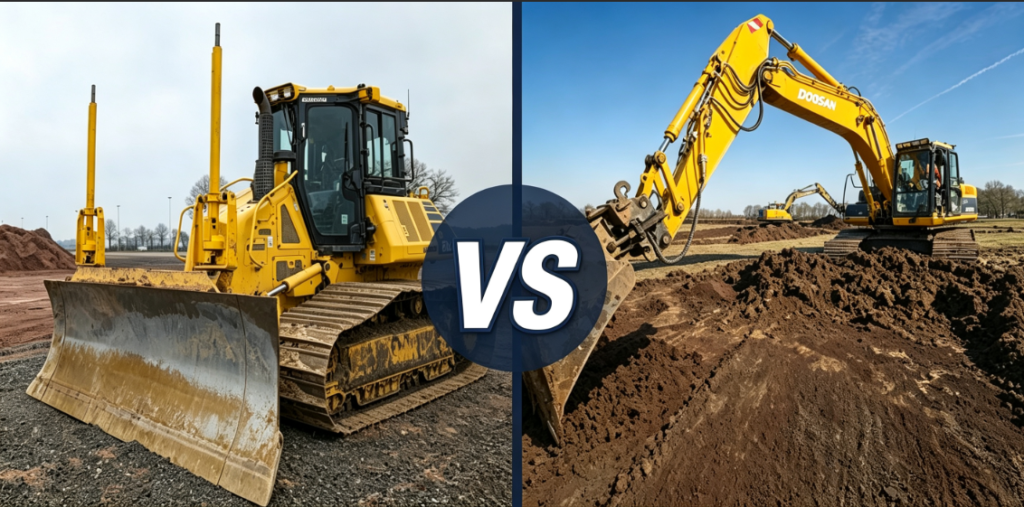
Saw a Reddit thread the other night that sums up the whole excavator vs. dozer debate.
A homesteader wants to dig a 5-hectare pond and asks which machine would do it fastest—comparable-price excavator, payloader, dozer, or payloader/backhoe.
He’s run excavators and a dump trailer before, but in his new area prices are crazy—payloader/backhoes cost as much as a same-size excavator—so he’s leaning toward an excavator + dump trailer combo for better dollar-per-yard.
As he put it: “We as homesteaders have many opportunities to take chances, make mistakes, and get messy… but the most fun one for me is heavy machinery for shaping the land.”
That’s the excavator dozer question in a nutshell. And it’s worth digging into, because the fastest machine on paper isn’t always the fastest machine on your dirt.
Excavator vs Dozer: How They Actually Move Earth
Let’s get the basics out of the way so we’re all on the same page.
An excavator is a digging machine. It sits on a set of tracks, has a rotating house (the cab and engine), and a boom and arm that reach out and pull dirt toward the machine. It’s a surgeon. It excavates precisely, drops material exactly where you want it, and can dig a straight wall faster than anything else on the planet.
A dozer, on the other hand, is a pushing machine. It’s a heavy track loader with a giant blade on the front. It doesn’t dig—it shoves. It takes massive amounts of loose dirt, rock, or debris and pushes it from point A to point B. If you need to move a mountain of dirt 200 feet across a site, the dozer is your guy.
When you watch an excavator dozer work side by side, the difference in motion is obvious. The excavator swings, reaches, and curls. The dozer just leans forward and bulldozes.
But here’s where it gets interesting. The real difference isn’t just how they move dirt—it’s how they handle the ground underneath them. An excavator can sit on relatively soft ground because its weight is distributed across a wide track base, and it digs vertically.
A dozer needs traction. It needs to grip the ground to push. If you put a dozer on wet, sloppy clay, it’s going to spin its tracks and sink. If you put an excavator in that same spot, it can still dig itself out using its boom, or just reach over and pull itself forward.
Excavator vs Dozer :Where Each Machine Shines
This brings us to the terrain question. A lot of guys ask, “Can I just use an excavator for everything?”
For a small residential lot, you can get away with using an excavator for 90% of the work. You can clear brush, dig footings, cut trenches, and load trucks. But if you have to clear a massive area of topsoil and push it into a berm, you’re going to be there all week with an excavator. You’ll be swinging 40 times a minute just to move what a dozer moves in two passes.
Dozers are built for flat or gently rolling ground. They excel at long, linear pushes. If you’re building a road, a large parking lot, or a subdivision pad, the dozer is the king of bulk earthmoving.
But put a dozer on a steep slope, and it becomes a liability. It can’t dig into the hillside to flatten it; it just slides. An excavator, however, can sit at the bottom of a steep hill, reach up, and pull the dirt down to it.
It can also sit on top and dig its way down. That’s why you almost never see a dozer on a steep residential hillside—you see an excavator with a thumb, picking away at the slope.
The 2026 Reality: Tech, GPS, and the Modern Job Site
The game has changed a lot in the last few years. In 2025, it’s not just about iron and hydraulics anymore. It’s about data.
If you’re running a dozer without GPS grade control, you’re losing money. Modern dozers come with 3D GPS systems that automatically adjust the blade to match a digital site plan.
The operator just drives, and the machine does the math. This is huge for finish grading. You can get a pad flat to within a tenth of a foot without ever getting out of the cab.
Excavators have caught up, too. 2D and 3D grade control systems for excavators are becoming standard on larger job sites. They tell the operator exactly how deep they’re digging, how far they’re reaching, and where the slope is. This takes the guesswork out of digging around utilities or hitting precise depths for footings.
But here’s the catch: all that tech makes the machines more expensive to buy, maintain, and repair. If you’re a small contractor, you might not need a $150,000 dozer with full GPS. You might be better off with a used excavator and a laser level.
Attachments: The Excavator’s Secret Weapon
One of the biggest reasons excavators have become so popular is their versatility. A dozer does one thing: it pushes dirt. Sure, you can swap the blade for a ripper, but that’s about it.
An excavator is a modular tool carrier. You can put a bucket on it and dig. You can put a hydraulic breaker on it and demo concrete. You can put a grapple on it and move logs.
You can put a compactor on it and pack trenches. You can put a mower on it and clear brush. You can even put a tiltrotator on it and do finish grading that rivals a dozer.
When you look at the pure utility of an excavator dozer comparison, the excavator wins on flexibility. If you only have the budget for one machine, and your work is varied, the excavator is almost always the smarter buy. The dozer is a specialist. The excavator is a Swiss Army knife.
The Cost of Ownership: What They Don’t Tell You
The purchase price of a mid-size excavator and a mid-size dozer are pretty comparable. You’re looking at anywhere from $80,000 to $200,000 depending on size, brand, and condition.
But the maintenance costs are where they diverge.
Dozers live and die by their undercarriage. The tracks, sprockets, idlers, and rollers take a beating because the machine is constantly pushing against heavy resistance. A dozer undercarriage rebuild can easily run you $20,000 to $30,000. And if you’re running in rocky or abrasive soil, you’ll be doing that rebuild more often than you’d like.
Excavators also have undercarriages, but they don’t wear out as fast because the machine isn’t constantly fighting the ground to push a load.
The main wear items are the hydraulic pumps and the pins and bushings in the boom and arm. A hydraulic pump replacement isn’t cheap, but it’s a different kind of maintenance.
Fuel is another factor. Dozers are notoriously thirsty. They’re pushing massive amounts of dirt, and that requires horsepower.
Excavators can be surprisingly fuel-efficient because they operate in a more controlled, cyclical motion. If you’re worried about fuel costs on a long project, the excavator often wins.
Operator Skill: Who’s Easier to Run?
If you’re hiring an operator, you know that a good one is worth their weight in gold.
Dozers are actually pretty straightforward to operate. You go forward, you go backward, and you move the blade up and down. The learning curve is mostly about learning how to read the ground and how to feather the blade to avoid digging in too deep. It’s a finesse game, but it’s not overly complex.
Excavators are a different beast. You’ve got two joysticks controlling four different functions (boom, arm, bucket, and swing). You’re controlling the tracks with your feet or hands, depending on the pattern. You’re swinging 180 degrees, dumping, and swinging back.
It takes a lot more coordination. A beginner on an excavator looks like a giraffe on roller skates. A beginner on a dozer just looks like they’re driving a slow tank.
If you’re trying to train someone from scratch, it’s usually easier to get them productive on a dozer faster. But a skilled excavator operator can do things that a dozer operator simply can’t, like digging a trench with a vertical wall, or picking up a pipe and setting it precisely in place.
Excavator vs Dozer: The Decision Framework
So, how do you decide? Forget the spec sheets. Look at your job site.
Choose a Dozer if:
- You need to move large volumes of dirt over a distance.
- You’re doing bulk site prep, like stripping topsoil or building a pad.
- The ground is relatively flat or has gentle slopes.
- You need to spread gravel or topsoil over a large area.
- You have a long, straight push to make (like a road or a berm).
Choose an Excavator if:
- You need to dig down. Deep trenches, basements, footings.
- You’re working in tight spaces where you can’t drive a dozer around.
- You need to load trucks. An excavator can load a dump truck in a few passes.
- You need to do demolition or handle materials with a grapple or breaker.
- The terrain is steep, uneven, or soft.
- You need precision. Digging around utilities, shaping a slope, or cutting a precise grade.
The Hybrid Approach: Using Both
Here’s the secret that the big grading companies know: the best job sites use both.
You bring in a dozer to strip the topsoil and rough grade the site. It pushes all the dirt into piles. Then you bring in an excavator to load those piles into trucks, or to dig the footings and trenches. The dozer does the heavy lifting, and the excavator does the detailed work.
If you’re a smaller contractor, you might not be able to afford both. In that case, you have to pick the one that does the most for your bottom line. If you’re doing a lot of utility work, get the excavator. If you’re doing a lot of new construction pads, get the dozer. And if you need the other one for a week? Rent it.
FAQ
Q:Can an excavator replace a dozer for land clearing?
Sort of. An excavator with a thumb and a rake can clear brush and trees just fine. But it’s slower than a dozer for pushing the debris into a pile. If you’re clearing 50 acres of heavy timber, you want a dozer with a root rake. If you’re clearing a half-acre lot, an excavator is fine.
Q:Which machine is better for working on a slope?
An excavator, hands down. A dozer will slide sideways and lose traction on a steep slope. An excavator can anchor itself with its boom and bucket, then pull itself up or down the slope safely.
Q:Do I need a dozer if I already have an excavator?
Not necessarily. For small to medium projects, an excavator can do 80% of what a dozer does, just slower. You only really need a dozer if you’re moving massive amounts of dirt over long distances.
Q:What’s the most common mistake people make when buying?
Buying too much machine. A guy doing residential landscaping doesn’t need a 40-ton excavator. He needs a 5-ton mini excavator and a compact track loader. The same goes for dozers. A 100-horsepower dozer is plenty for most site work. Don’t let the dealer upsell you into a machine that’s too big to haul and too expensive to maintain.
Conclusion: It’s About the Dirt, Not the Badge
At the end of the day, the excavator dozer debate isn’t about which machine is better. It’s about which machine is better for the dirt you’re moving today.
If your job is all about digging deep, precise holes and loading trucks, the excavator is your ride. If your job is about pushing vast plains of dirt into submission, the dozer is your weapon.
And if you’re lucky enough to have a big enough contract, you’ll have both on site. The dozer pushes the dirt into a pile, and the excavator picks it up and puts it where it belongs. It’s a beautiful thing to watch.
So, before you sign that rental agreement or cut a check for a new machine, take a long, hard look at your site plan. Let the dirt tell you what you need. The rest is just iron.
发表回复