This guide covers everything you need to know about what a wheel loader is, what it does, the different types, how to pick the right one, what to watch out for, and where the industry is heading.
What is a Wheel Loader? So you’ve seen one of those four-wheel-drive beasts on a construction site, a gravel pit, or maybe a farm. Big bucket on the front. Scoops up tonnes of rubble like it’s nothing. Dumps it into a truck like it’s scooping sand at the beach.
It’s not an excavator. It’s not a forklift. that is a wheel loader.
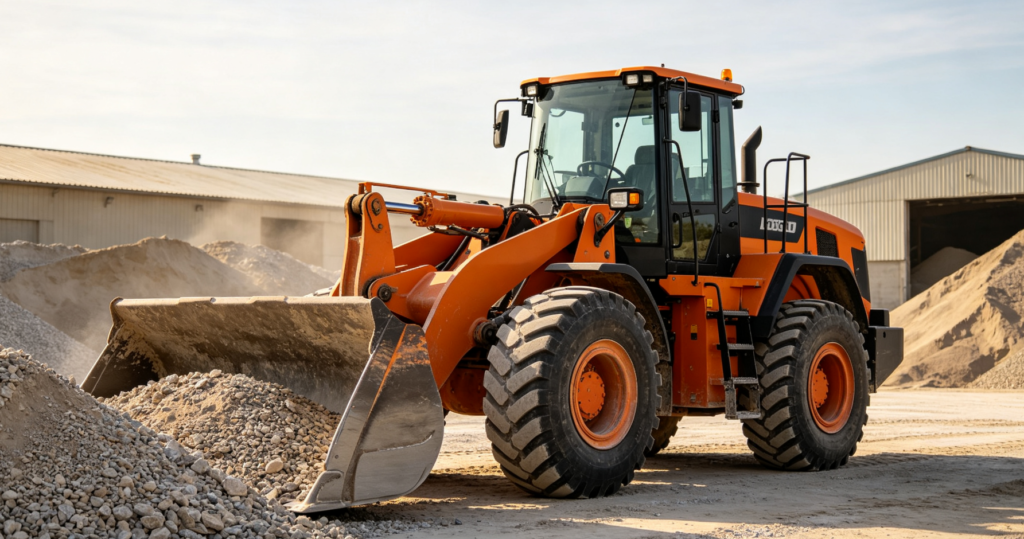
So, What is a wheel loader machine?
Think of it as a “super porter” on wheels.
At its core, a wheel loader is a self-propelled, front-loading machine. It does two things: scoops and carries. Unlike an excavator that digs down, a wheel loader pushes forward and lifts up.
Now, you might be thinking—”isn’t that just like the front loader on a farm tractor?”
Not really. A real wheel loader is a dedicated piece of heavy machinery. It’s got a proper hydraulic system, articulated steering (the middle of the machine bends to turn—crazy small turning radius), and heavy-duty axles built to handle serious weight day in, day out.
These things range from a few tonnes all the way up to over a hundred tonnes. Bucket sizes? Anywhere from 0.25 cubic metres to over 22 cubic metres. The smallest you’ll find is something like Lingong’s 0.25m³ loader; the big daddy is Caterpillar’s 22.3m³ monster.
Why do I call it “super”? Because a mid-sized wheel loader can shift hundreds of tonnes of material in an hour. That’s the work of a dozen manual labourers—except this one doesn’t take tea breaks.
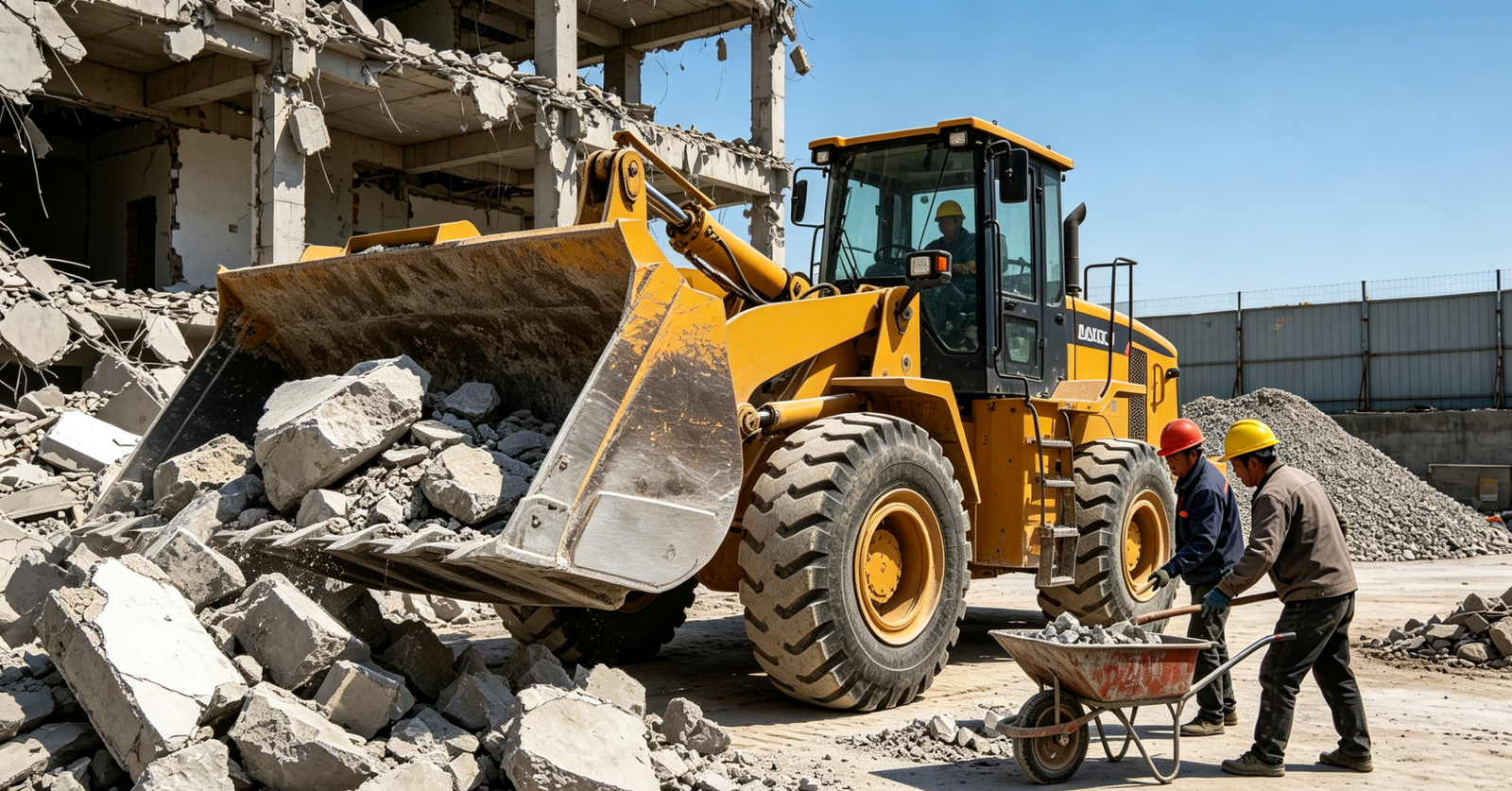
What is a wheel loader used for?
Most people think it’s just for shovelling dirt. That’s like saying a smartphone is just for making calls.
Here’s what they really do:
- Fast loading – Coal, sand, gravel, fertiliser, grain… if it’s in a pile and it’s granular, a wheel loader can load it into trucks in no time.
- Crushing and demolition – Swap in a rock bucket or a hydraulic breaker, and it’ll chew through blasted rock, concrete chunks, even take down small structures.
- Specialist jobs – Change the attachment, change the game. Timber grapple for logs. Sweeper brush for cleaning roads. Snow plough for winter. Work platform for lifting workers up high.
- Support work – Feeding material to pavers on road jobs. Hauling muck out of tunnels. Keeping the site moving.
The secret sauce? Quick-change attachment systems. If you spec the hydraulic quick coupler at purchase, you can switch tools in a few minutes. That’s why a wheel loader is way better value than a single-purpose machine—it’s like having a Swiss Army knife for your job site.
What types of wheel loaders are there?
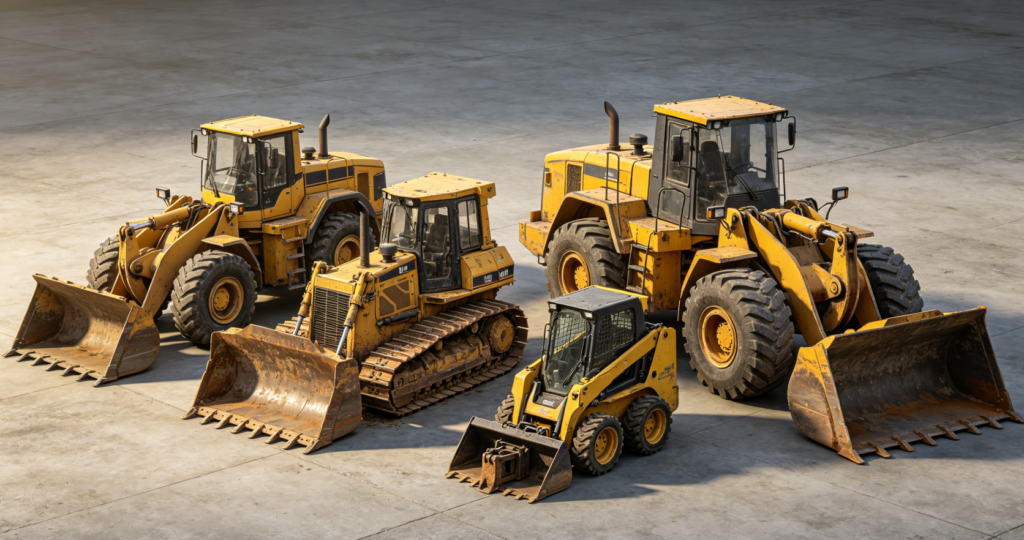
Struggling to decide? Here’s a cheat sheet:
| Situation | Go with | Why |
|---|---|---|
| Hard surfaces (concrete, gravel, firm dirt) | Wheel loader | Fast (up to 40 km/h), easy to move between sites, won’t damage the ground |
| Mud, swamp, steep slopes | Track loader | Low ground pressure, won’t sink or slip—but slower and can mark up asphalt |
| Tight spaces (factories, narrow alleys) | Skid-steer loader | Compact, can turn on the spot |
| Wide open spaces (quarries, ports) | Large wheel loader | Maximises efficiency—bigger bucket, bigger loads |
Budget tip: if you’re only loading occasionally and the site is tricky, consider renting or buying second-hand. For long-term, fixed-site work, a wheel loader gives you better value than a track loader—tyres are cheaper to maintain than tracks. Simple as that.
New or Second-Hand? What to Check Before Buying
Whether it’s brand new or been around the block, here’s what matters:
1. Engine – Does it have enough grunt for your conditions? For tough sites, go with a reputable brand engine. For lighter work on a tight budget, prioritise fuel economy.
2. Transmission – Look for “fixed-axis” or “planetary gear” types—they’re tougher and cheaper to fix. Test drive it: listen for smooth shifts and any weird noises.
3. Hydraulics – Lift and tilt smooth? Any oil leaking from the valve block? Scratches on the hydraulic cylinders? These will hit your wallet down the line.
4. After-sales service – Loaders get banged up. Before you buy, make sure the brand has a solid service network in your area. Nothing worse than a broken machine and no one to fix it.
Maintenance and Safety: What Operators Often Ignore
Most operators just want to get the job done. But skipping the basics is how machines end up in the shop every other week.
A few quick ones:
- Tyre pressure – Don’t pump them like car tyres. Wheel loader tyres run low—around 3–5 atmospheres—to spread the weight and avoid sinking. Over-inflate and you’ll get blowouts or slippage.
- Daily checks – Hydraulic oil, engine oil, coolant, air filter. On dusty sites, blowing out the air filter daily can literally double your engine life.
- Smart operation – When you go into a pile, ease in. Don’t charge. You’ll wreck the bucket edge and the axles. And when reversing? Check your blind spots—the blind spots on these things are huge. A reversing camera and radar are worth every penny.
Electric and Smart Loaders: They’re Here Already
It’s 2026. Electric wheel loaders aren’t a concept anymore—they’re real and they’re working.
Right now in China, you can buy all-electric wheel loaders with bucket capacities from 0.4m³ to 4.5m³. That covers most normal job sites. In enclosed mines and tunnels, electric loaders give you zero emissions, low noise, and running costs about a third of diesel machines.
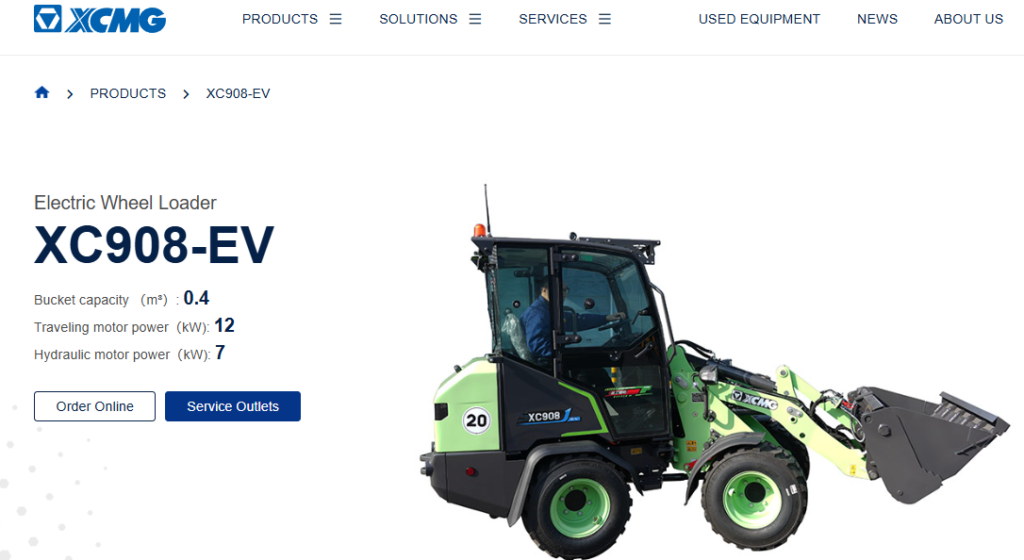
Smart tech? It’s moving fast. More models come with automatic weighing systems, slope control, remote control—even fully unmanned operation.
If you’re buying for a long-term project, do yourself a favour: make sure the machine has interfaces to add these systems later. Future-proofing beats playing catch-up.
One Last Piece of Advice
A wheel loader isn’t just metal and hydraulics. It’s the engine of your site’s productivity. Pick the right one, and your timeline shrinks, your costs drop, and life gets easier. Pick the wrong one, and it’ll eat fuel, eat maintenance, and eat your sanity.
Here’s my rule of thumb:
- Project under 1 year → rent. There are plenty of online rental platforms.
- Project over 3 years → buy new and sign a full-lifecycle maintenance agreement.
And one more thing—the buyers who really know their stuff? They don’t just read brochures. They get in the cab. Test the seat. Check the visibility. Feel the controls. Those little “human-machine” details matter way more than any spec sheet. Don’t skip the test drive.
FAQs About Wheel Loaders
Q: What is the difference between a front loader and a wheel loader?
A: Honestly? In most cases, they’re the same thing. “Front loader” is a general term for any loader with a bucket on the front—including tractors with a loader attachment.
“Wheel loader” is more specific: a self-propelled, dedicated machine with tyres. So all wheel loaders are front loaders, but not all front loaders are wheel loaders. But if you’re talking about the big yellow machine on a site, people use both terms interchangeably and everyone knows what you mean.
Q: Is a wheel loader the same as a skid steer?
A: No, not even close. Skid steers are tiny in comparison, light, and they turn by skidding their wheels (hence the name). Wheel loaders are big, heavy, and use articulated steering—the machine bends in the middle to turn.
A skid steer fits through a barn door. A wheel loader needs a quarry or a port to stretch its legs. Totally different tools for totally different jobs.
Q: What is another name for a wheel loader?
A: Depending on who you’re talking to, you might hear “front loader,” “bucket loader,” or just “loader.” In the UK, some people still call it a “shovel” (which is confusing because a shovel is also a hand tool).
But if you want to be precise and sound like you know your stuff, stick with “wheel loader.”
Q: Why is it called a skid loader?
A: Because it doesn’t steer like a normal vehicle. Instead of turning the wheels, it brakes one side and drives the other, which makes the wheels “skid” across the ground. That’s literally where the name comes from. And the name stuck—even though modern ones are smoother, the physics is basically the same.
Q: What is a wheel loader operator?
A: The person sitting in the cab, pulling the levers. A good operator does more than just drive—they control the hydraulics with precision, manage the machine’s weight and balance, and keep an eye on safety (blind spots are huge).
It takes skill to fill a truck in three smooth scoops without spilling, or to work on uneven ground without tipping. Some operators specialize in tight conditions like tunnel mucking; others excel at fast-cycle port loading.
Bottom line: the machine is only as good as the person driving it. And a skilled operator can make a budget loader perform like a premium one.
发表回复