As well as outlining the features of these two devices, this article will also provide a detailed comparison of them from perspectives that are rarely discussed in depth, such as hidden costs, security differences and future trends.
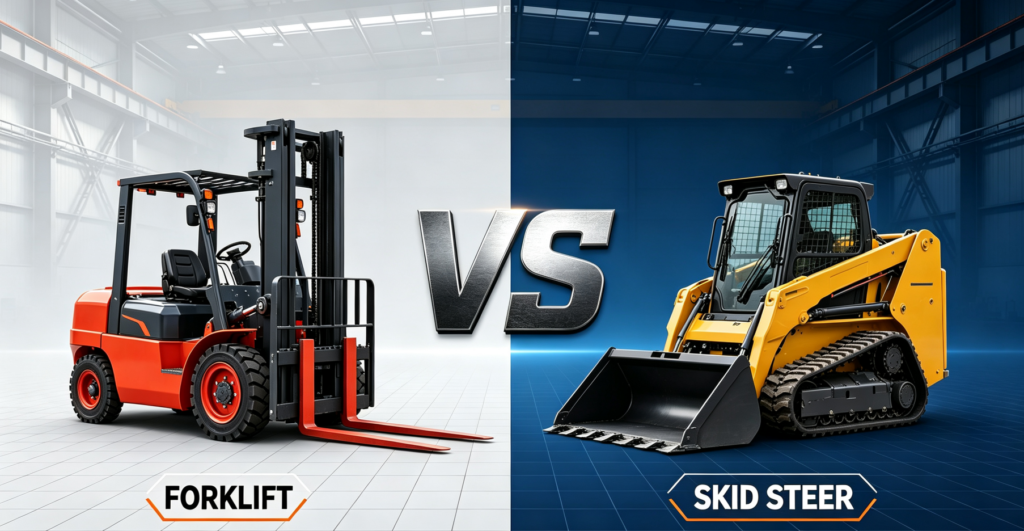
Skid steer vs forklift: Features of each product
Skid steer – a versatile all-rounder
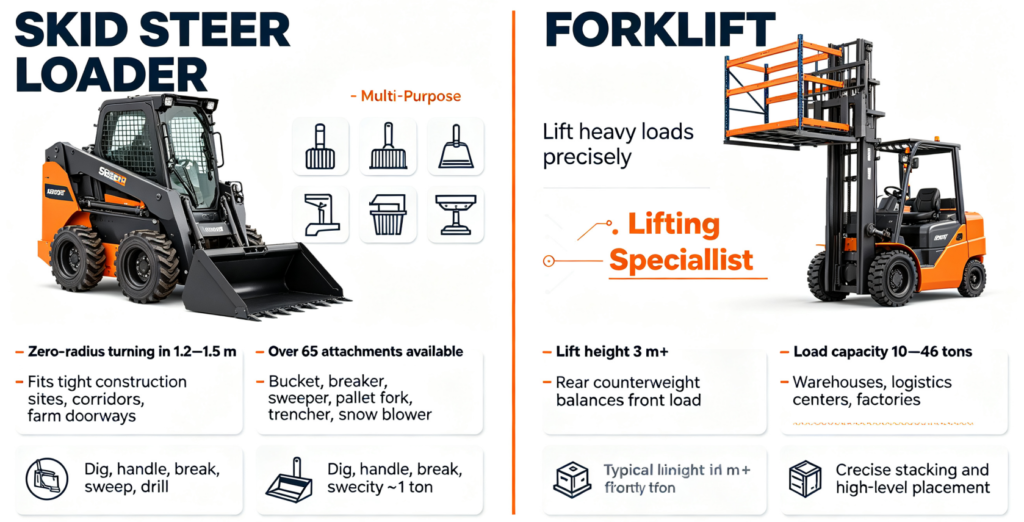
The machine’s greatest strength is its ability to turn on the spot. Its turning circle is just 1.2 to 1.5 metres, whereas a standard loader needs 15 to 20 metres to complete a turn. It can manoeuvre into narrow construction sites, stairwells and even the entrances to chicken coops.
Another key feature is its ability to change attachments. Buckets, sweepers, snow blowers, milling machines, forks, land levellers… there are over 65 types of attachments available on the market.
A single machine can handle digging, moving, crushing, sweeping and a whole host of other tasks.
Forklift— a dedicated weightlifting champion
A forklift has just one job: to lift heavy objects and place them where they need to go.
It uses a counterweight at the rear to balance the load at the front; it can lift to a height of 3 metres or even higher, with a lifting capacity ranging from 10 tonnes to 46 tonnes.
In flat indoor environments such as warehouses, logistics centres and factories, forklift trucks are an essential piece of equipment. Precise stacking and high-level storage are tasks that skid-steer loaders simply cannot perform.
Skid steer vs forklift:Five dimensions to determine the winner
1. Manoeuvrability
Skid-steer loaders can turn on the spot and are as nimble as eels on narrow construction sites.
Forklift trucks steer via their rear wheels, so they have a much larger turning circle and require even more space when fully loaded.
2.Terrain Adaptability
Skid-steer loaders are designed for complex terrain. Mud, gravel and slopes are no problem at all. The tracked versions can even ‘float’ over soft ground, whereas a forklift would sink right up to its axles simply because of its own counterweight.
A forklift is like a fish out of water when it’s off concrete. Anyone attempting to drive a forklift onto a gravel construction site is bound to get stuck.
3.Versatility
A skid-steer loader is like a ‘Swiss Army knife’: one day it’s digging, the next it’s clearing snow, and the day after that it’s drilling holes; all it takes is a change of attachment to suit different tasks.
A forklift, on the other hand, is a ‘specialist’; whilst it performs its task with precision, it can only do that one job.
4.Operational Efficiency
For short-distance bulk goods handling, skid-steer loaders are faster.
For high-level, precision stacking, forklifts are far superior.
This is because the vertical mast of a forklift raises and lowers steadily and in a straight line, whilst the lift arm of a skid-steer loader offers poor visibility and is significantly less stable.
5.Safety Differences
This is rarely discussed, but it is particularly crucial.
Forklifts are more stable when stacking goods on flat ground. However, once the ground becomes uneven, the risks increase—when a forklift overturns, it usually tips over onto its side.
Skid-steer loaders are more stable on rough terrain, and tracked versions are available. However, when lifting heavy loads with forks, their short wheelbase makes them feel much more ‘unsteady’ than forklifts. When skid-steer loaders overturn, it is usually a forward roll (as their maximum load capacity is around 1.29 tonnes, they cannot handle excessively heavy loads).
There is no such thing as an absolutely safe piece of equipment; there are only safe and unsafe operating practices.
When buying equipment, you shouldn’t just look at the list price. Some costs are obvious, whilst others ‘creep up’ gradually.
Purchase versus Rental Costs
For example, a standard skid-steer loader costs around US$50,000, whilst a standard forklift truck typically costs around US$30,000. (This example excludes specialised forklift trucks.)
However, the calculation is not quite that simple. For long-term projects lasting five years or more, a skid-steer loader-led fleet is more cost-effective; for short-term projects lasting three years or less, a forklift truck-led fleet is more economical. This is because a single skid-steer loader can perform the work of multiple machines, thereby reducing the cost when spread over each year and each project.
Whether to buy or hire depends on the nature of your work. Typically, a construction site will be equipped with one skid-steer loader, supplemented by a hired forklift; the skid-steer loader is deployed wherever it is needed, whilst the forklift is reserved for unloading non-bulk materials.
Maintenance Costs
Maintenance of skid-steer loaders focuses on the hydraulic system and attachments. The hydraulic system operates at high pressures (up to 200 bar), which demands rigorous maintenance. Some people, seeking a bargain, have purchased imitation skid-steer loaders only to find the hydraulic hoses burst twice within two months; the repair costs nearly matched the purchase price.
Forklift maintenance focuses on the mast, chains and drive system. Maintenance intervals are relatively longer; the gearbox only requires servicing every 800 hours.
There is another point that many people overlook: the tyres on skid-steer loaders. All-terrain tyres are more expensive than standard tyres, whilst tubeless tyres, although pricier, can save $100 in fuel costs per 10,000 kilometres. This must be factored into the calculations.
Operator Costs
Operating a forklift and a skid-steer loader place different demands on the operator. Skid-steer loaders are more complex to handle, with frequent changes of attachments, each requiring different operating techniques. Inadequate training can result in anything from low efficiency to accidents.
Some users have reported that new machines come with only two hours’ training, whilst it actually takes at least three months to become proficient. Many project managers have simply not factored in these labour and time costs.
Losses due to downtime
Once equipment breaks down, it delays the progress of the entire project. Are spare parts for skid-steer loaders easy to source? Can repair technicians arrive promptly? These are issues that must be carefully considered at the time of purchase.
Some have purchased machines from niche brands; when they break down, they have to wait half a month for spare parts, leaving the site at a standstill for half a month—a loss far greater than the cost of the repairs.
Skid steer vs forklift:So how do you choose?
If you:
– Work on outdoor sites with uneven, muddy or sloping ground
– Operate in confined spaces where large machinery cannot access
– Have a varied workload—shovelling earth one day, sweeping the next, and crushing the day after
– Need a single machine to handle multiple tasks
————Choose a skid-steer loader
If you:
– Your main tasks involve loading and unloading pallets and stacking goods
– The ground is hard-surfaced, such as concrete or tarmac
– You need to lift goods to a height of over 3 metres, weighing 2 tonnes or more
– The working environment is relatively straightforward and repetitive
————Choose a forklift
Scenario A: Urban construction site, confined space, varied tasks → Skid-steer loader
Scenario B: Large warehouse, handling hundreds of pallets daily, high-level stacking → Forklift
Scenario C: Farm, handling feed, cleaning livestock pens, moving round bales → Skid-steer loader
Scenario D: Port, loading and unloading containers on hard surfaces → Heavy-duty forklift
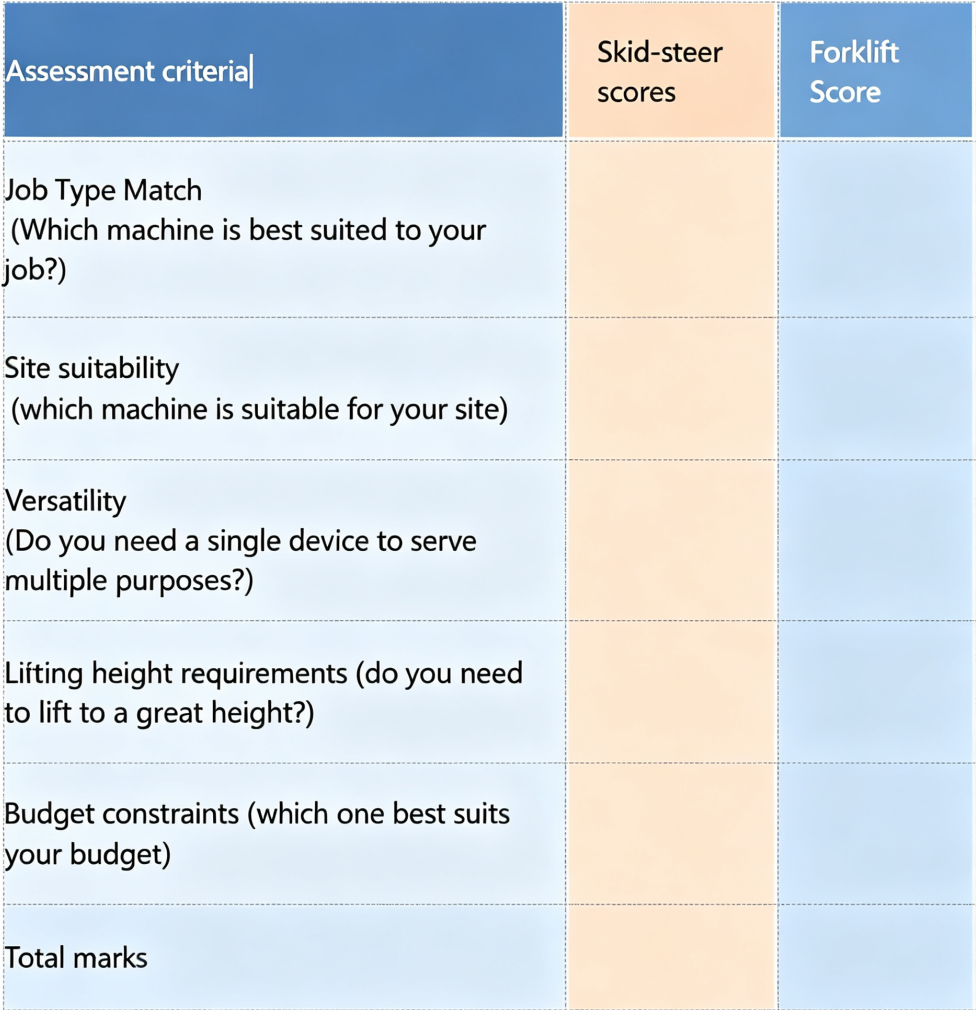
Simple decision-making tools
FAQ
Can a skid-steer loader be used as a forklift?
Yes. All you need to do is fit a fork attachment. However, there are a few limitations: the lifting height is not as high as that of a dedicated forklift (generally only 2.8 to 3.5 metres); the load capacity is limited; and the forward view is obstructed by the lifting arm, resulting in significantly reduced operational precision. It is suitable for occasional use, but it is not practical to use it as your main forklift.
Can a forklift be used as a skid steer loader?
Yes, but with a limitation: a bucket must be fixed to the front fork. The limitation lies in the fact that the forklift’s front fork does not have a very large tilt angle, making loading and unloading rather difficult.
Skid steer vs forklift:Which is safer?
There is no such thing as an absolutely safe piece of equipment; there are only safe and unsafe operating practices. Forklifts are stable when stacking on level ground, whilst skid-steer loaders are stable when travelling on rough terrain. It ultimately depends on operator training and an assessment of the working conditions.
Skid steer vs forklift:Which offers better value for money?
It depends on your business model. Single-purpose operations (purely warehouse work) → forklifts offer better value for money. Diverse operations (comprehensive construction work) → the versatility of skid-steer loaders provides greater value.
Outlook: What will forklifts and skid-steer loaders look like in the future?
This topic is worth a brief discussion.
Electrification is already a major trend. The skid-steer loader industry is undergoing a comprehensive transition to zero-emission electric models. The penetration rate of electric forklifts is also rising rapidly; in sectors with high environmental standards—such as food, beverages and pharmaceuticals—they are gradually replacing internal combustion forklifts. In the first half of 2025, sales of autonomous forklifts increased by 266.7 per cent year-on-year.
Intelligent technology is also advancing at a rapid pace. Remote intelligent control, unmanned autonomous operation, automatic navigation and fault early warning – features once seen only in science fiction films are now becoming a reality. Electric drive platforms are being deeply integrated with intelligent control, remote monitoring and AI-powered energy management.
In future, you will be able to sit in your office and remotely control a skid steer loader or forklift working on a construction site. This is not a dream; it is already happening.
Other articles
发表回复