Retroexcavadora—known on job sites as a backhoe loader, or just a “backhoe”—is one of the easiest pieces of equipment to get wrong.
Small contractors buying their first machine almost always get lured in by peak horsepower numbers, sign for a unit that can’t reach the trench, and then spend the next three years fighting with the hydraulics, service intervals, and resale value.
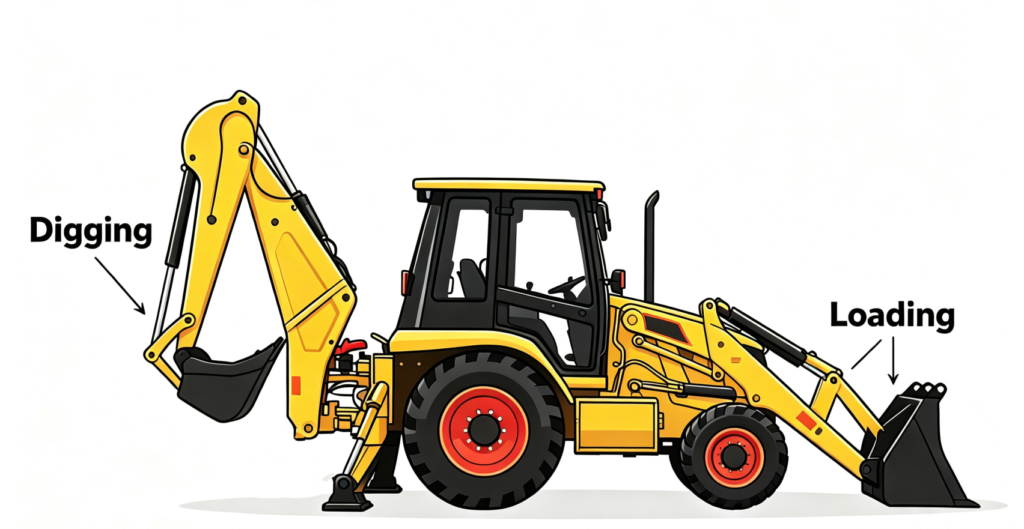
What is Retroexcavadora used for
It’s essentially a tractor chassis with two work tools bolted on: a front loader for scooping, lifting, hauling, and rough grading, and a rear backhoe for digging. One operator, one machine, one set of tires—load up in the morning, then drive yourself to the pit you just dug by noon.
Its value isn’t in peak performance. It’s in how cheap it is to move around. A tracked excavator of the same class needs a lowboy and often a transport permit; a seven-ton backhoe loader can drive itself thirty or forty kilometers, hopping between three or five sites in a day. The money and time you save on trailers alone can cover months of fuel in a year.
In one sentence: it solves “variety,” not “volume.” If you’re digging 200 meters of trench a day, six days a week, on a fixed rhythm, buy a dedicated excavator. This machine is just a waste of money.
How Retroexcavadora Differs from an Excavator or Dozer
Compared to an excavator: a tracked excavator can spin in place and stand on ground so soft it would swallow a truck, but it’s slow and can’t drive on the road. A backhoe loader runs on wheels and uses stabilizers to hold itself steady when digging. The bigger difference is swing—an excavator can rotate 360 degrees and dump without moving the machine. A backhoe only swings through a扇形 arc, which is why nobody uses one for continuous digging below five or six meters.
Compared to a dozer: a dozer is a pure pushing machine. The blade is fixed to the front, and it relies on track power to push dirt over long distances. It’s great for site leveling, but it can’t dig a trench or load a truck precisely.
Its sweet spot is clear: small volumes, multiple locations, mixed tasks, and the ability to drive itself on public roads. Outside that zone, it stops making financial sense.
Where It Works Best
The classic use case is municipal and utility work—short trenches, frequent moves, road restoration, spoil loading. The digging volume isn’t huge, but the task switching is constant. Next is residential and light commercial: foundation trenches, utility runs, site cleanup, backfill, material handling.
It’s common to see one machine dig a foundation in the morning and then use the loader to bring in pallets of brick and mortar in the afternoon. Then there’s agricultural earthmoving, landscaping, and road maintenance—the kind of work that never stops coming in small doses.
Three types of work should not go to this machine: long-distance, high-volume earthmoving; continuous deep excavation below five or six meters; and fine grading work that demands precision.
The Real Differences Between Brands
About three-quarters of a machine’s lifetime cost is locked in before you even turn the key: emissions strategy, hydraulic architecture, transmission type, and dealer radius. Look at brands through those four lenses.
CAT 416 / 420 / 426: Hydraulics Are the Core
All three models share one logic: load-sensing with a variable piston pump. The 416’s pump puts out 132 L/min at 2,200 rpm and 23,000 kPa (CAT 416 spec sheet). A variable pump supplies oil on demand rather than pushing a fixed displacement against resistance, so you still have digging force at low RPM and fine control at idle.
The 416 also gets upgraded brakes and a wider cab (TRACSA comparison). The 4.4-liter engine makes about 397 N·m at 1,400 rpm—torque tells you more about how it’ll behave in clay than peak power does. Bucket force is 59,118 N, stick force 32,378 N (CAT 416 spec sheet).
The 420 adds three things: a brake mode selector (lets you lock two-wheel drive into four-wheel drive), a quick-release dual-lock coupler, and an extendable stick (adds 1.2 meters of reach). Hydraulics jump to 163 L/min and 25,000 kPa (TRACSA comparison; CAT 420 spec sheet). The 426 is close to the 420 but adds a side-shift backhoe and a narrower body, built for tight spaces.
Case: 575SV for Simplicity, Serie N for Lifting
Case makes lifting its signature. The Serie N runs from the 580N at 79 hp to the 590 Super N at 108 hp, with net torque from 366 to 515 N·m at 1,400 rpm (Case Serie N brochure).
The key feature is Power Lift, a one-touch boost that Case says raises backhoe lift capacity by 65% over a conventional machine in the same class. Outboard wet disc brakes can be serviced without pulling the rear axle—at the 4,000-hour mark, that’s real money.
The 575SV takes the value route: a 3.9-liter turbocharged intercooled engine with mechanical injection, 94 hp at 2,200 rpm, 420 N·m at 1,300 rpm, Tier III with EGR, no DEF (Case 575SV manual). It’s low on electronics, which suits buyers who want to do their own maintenance.
New Holland D Series: Pushing Maintenance Costs Down
Power ranges from 74 hp on the B75D to 110 hp on the B110D, all using a 3.4-liter four-cylinder FPT F5 engine with DOC + DEF + SCR to meet Tier 4 Final. Peak torque runs from 316 to 460 N·m at 1,400 rpm (New Holland D Series manual).
The standout is the aftertreatment: Compact HI-eSCR was developed around a “maintenance-free” idea—no filter changes, no cleaning, no downtime for the life of the machine. Anyone who’s lost half a shift to a regeneration cycle knows how much that matters.
Two hydraulic architectures are available: a dual gear pump with mechanical controls, constant flow up to 39.8 gpm and 2,973 psi; or a variable pump with pilot controls, 1.5 to 41.2 gpm on demand, which runs cooler during continuous backhoe work.
Loader lift to full height tops out at 8,157 lb (B75D); bucket force ranges from 12,138 to 13,418 lbf on the B110D; digging depth goes from 14 feet 5 inches with the standard stick to 19 feet 4 inches with the extendable stick. Service intervals are the longest in this group.
JCB 3CX / 1CX / 1CXT: Two Different Species Under One Brand
The 3CX is the full-size workhorse: 5.97 m digging depth, 6.52 m reach, 0.28 m³ bucket, 81 kW total power, 40 km/h top speed, 7,887 to 8,600 kg operating weight (JCB official 3CX specs).
The 1CX is a different animal: 3.08 m digging depth, 0.78 m³ bucket, 36.3 kW, 11 km/h top speed, 3,174 to 3,254 kg (JCB official 1CX specs). It’s not a scaled-down 3CX—it’s a compact loader with a digging arm. The 1CXT puts the same body on tracks: same depth and power, bucket drops to 0.36 m³, top speed 7.5 km/h, weight 4,342 kg (JCB official 1CXT specs).
Deere’s L Series sits in the same class as Case N Series and CAT 400 Series. At this level, performance gaps are tiny. What actually decides the outcome is dealer distance and parts speed—a second-tier brand with a dealer twenty minutes away will always beat a first-tier brand that takes four hours to get a tech on site.
Disadvantages of different brands of retroexcavators
CAT 416/420:
The weak spots are electronics and price. The variable pump supplies oil on demand, which is great, but it also means more sensors and a more complex valve block. When something fails, repair costs and diagnostic difficulty are higher than with a fixed-displacement gear pump machine. CAT machine and parts prices are also on the high side for the class.
Case 575SV:
The weak spots are regulatory fit and resale. Tier III with EGR and no DEF is genuinely simpler to live with, but that route limits marketability in regions where emissions rules are tightening. The buyer pool for resale is smaller.
The Serie N’s Power Lift is impressive, but the trade-off is a hydraulic system that lives at higher pressure, which puts more demand on oil cleanliness and filter discipline.
New Holland D Series:
The weak spots are the electronic system and aftertreatment trust. HI-eSCR being maintenance-free is a paper promise; real-world performance depends heavily on DEF quality and usage management. Tier 4 Final adds a whole aftertreatment hardware package compared to older machines, so long-term repair costs are more of an unknown than with a mechanical injection model.
JCB 3CX:
The weak spot is configuration price elasticity. A 50 km/h version, different bucket sizes, and stick combinations can swing the quote significantly. Negotiating on a base spec and then adding options later is an easy way to blow the budget. The 1CX and 1CXT are more direct: if any part of your job requires digging below 4 meters, these two machines are wrong from day one.
Buying Guide
First, map out your work structure. Break down the last twelve months of hours into digging, loading, grading, and travel. If loading and material handling are over 60%, prioritize lift capacity, bucket width, and self-leveling—the Case 580 Super N WT and New Holland B75D both deliver 8,157 lb.
If backhoe work is over 60% and you’re often on the road, focus on variable pump models. The New Holland pilot version’s 1.5 to 41.2 gpm on-demand flow is exactly right. If you’re always in tight spaces, side-shift and a narrow body are non-negotiable—the CAT 426 exists for this.
Second, watch the four numbers that actually constrain you, and don’t get distracted by peak horsepower.
①: “dig depth at 2 feet flat bottom,” not maximum dig depth—the latter is measured at a theoretical point and means little in practice.
②: bucket force and stick force must be read together. Bucket force decides whether you can bite into the pile; stick force decides whether you can drag the bucket through it.
③: flow and pressure need to be read as a pair. A variable pump can deliver force at low RPM; a fixed-displacement pump can’t.
④: “lift to full height with the actual attachment.” A 4-in-1 bucket weighs far more than a general-purpose bucket, and that weight comes straight off your lift capacity.
Third, lock down the attachment plan before you talk color. The right question isn’t “which brand is best”—it’s “which brand can get me a breaker, auger, grapple, and quick coupler at a reasonable price.” A hydraulic quick coupler costs more upfront, but it saves about ten minutes per swap. Swap three times a day and it pays for itself within a year. When buying, always confirm whether auxiliary hydraulics are pre-plumbed—the B95D and B110D offer an optional 0 to 35.9 gpm auxiliary circuit, and adding it later is very expensive.
Fourth, calculate total cost of ownership, not purchase price. The invoice is only about 40% of the real cost. Start by comparing service intervals: a machine with 500-hour oil changes versus one with 250-hour changes will do twenty fewer services over its life. Then ask about aftertreatment: HI-eSCR is maintenance-free; the 575SV doesn’t need DEF but has a narrower resale market in strictly regulated areas. Each path has its price.
Fifth, don’t forget resale value—and don’t forget the dealer. A machine that costs 15% more but sells for 25% more used is the cheaper machine.
FAQ
Q: How much does a retroexcavadora cost? What drives the price?
Configuration matters far more than brand: two-wheel drive or four-wheel drive, open canopy or air-conditioned cab, standard or extendable stick, quick coupler or not—the range can be huge.
Emissions tier is just as important: Tier 4 Final comes with SCR hardware and DEF lines, while a Tier III mechanical machine like the Case 575SV doesn’t. Get quotes from three dealers on a fixed configuration, and compare five-year total cost of ownership, not the invoice.
Q: Is four-wheel drive worth the extra money?
In almost every real-world condition, yes. With a big bucket hanging off the front, two-wheel drive is most likely to slip on wet clay, sand, or soft ground—exactly when you need traction. Four-wheel drive improves loader performance, and the loader is where this machine earns its keep. Treat it as insurance, not an upgrade.
Q: Standard stick or extendable stick?
A standard stick gives you the base digging depth, usually 14 to 15 feet. An extendable stick uses a hydraulic sliding structure to push depth to about 19 feet, but digging force and lift capacity drop when it’s extended. Buy it if you regularly dig deep utilities or want to cut a wider trench from one parking spot. Skip it if your work is shallow and you want maximum force.
Q: Can one backhoe loader replace a mini excavator plus a skid steer?
For some small contractors, yes—that’s why it’s still around. It drives itself on the road, comes close to a compact excavator for digging in the 3-meter range, and comes close to a compact wheel loader for loading. But it can’t replace long, continuous excavation, and it can’t get inside a building. It replaces two machines in mixed work, but it doesn’t replace either dedicated machine.
Q: How many hours is too many on a used machine?
Don’t fixate on the number. Look at the ratio of hours to condition. A 6,000-hour machine with complete records, clean oil samples, tight pins, and no leaks is a better buy than a 3,000-hour machine with a messy history. Focus on the backhoe swing tower, loader linkage, and hydraulic pump. And confirm the emissions tier is legal where you operate—a great machine with the wrong certification is still unusable.
Final Thoughts
At a Glance: One Thing to Remember About Each Brand Series
| Brand / Series | The One Thing to Remember |
|---|---|
| CAT 416 / 420 / 426 | Load-sensing variable piston pump delivers digging force at any RPM; the 426 has a side-shift option for tight spaces. |
| Case 575SV / Serie N | Lifting capacity is the claim to fame; Power Lift one-touch boost; the 575SV is a simplified Tier III machine that doesn’t need DEF. |
| New Holland D Series | HI-eSCR maintenance-free aftertreatment, longest service intervals, and two hydraulic architectures to choose from. |
| JCB 3CX / 1CX / 1CXT | The 3CX is the full-size workhorse; the 1CX and 1CXT are compact loaders with a digging arm—don’t compare them to the 3CX on price. |
The order for choosing a retroexcavadora is actually pretty fixed: define your work structure first, then look at dig depth at 2 feet flat bottom and the two digging forces, then lock in your attachment plan, and only then talk to dealers. Buy the machine you’ll still want to keep at 4,000 hours—not the one that wins the spec-sheet comparison at hour zero.
This table is just for first impressions, not a ranking. In the real world, dealer distance and parts availability often matter more than any spec on paper.
This article only covers which brand’s design philosophy suits which kind of work, and where the weak spots are. All brand specs are sourced: CAT 416 spec sheet, TRACSA’s CAT 416/420/426 comparison, Case 575SV manual and Serie N brochure, New Holland D Series manual, and JCB official spec pages.
Other articles
发表回复